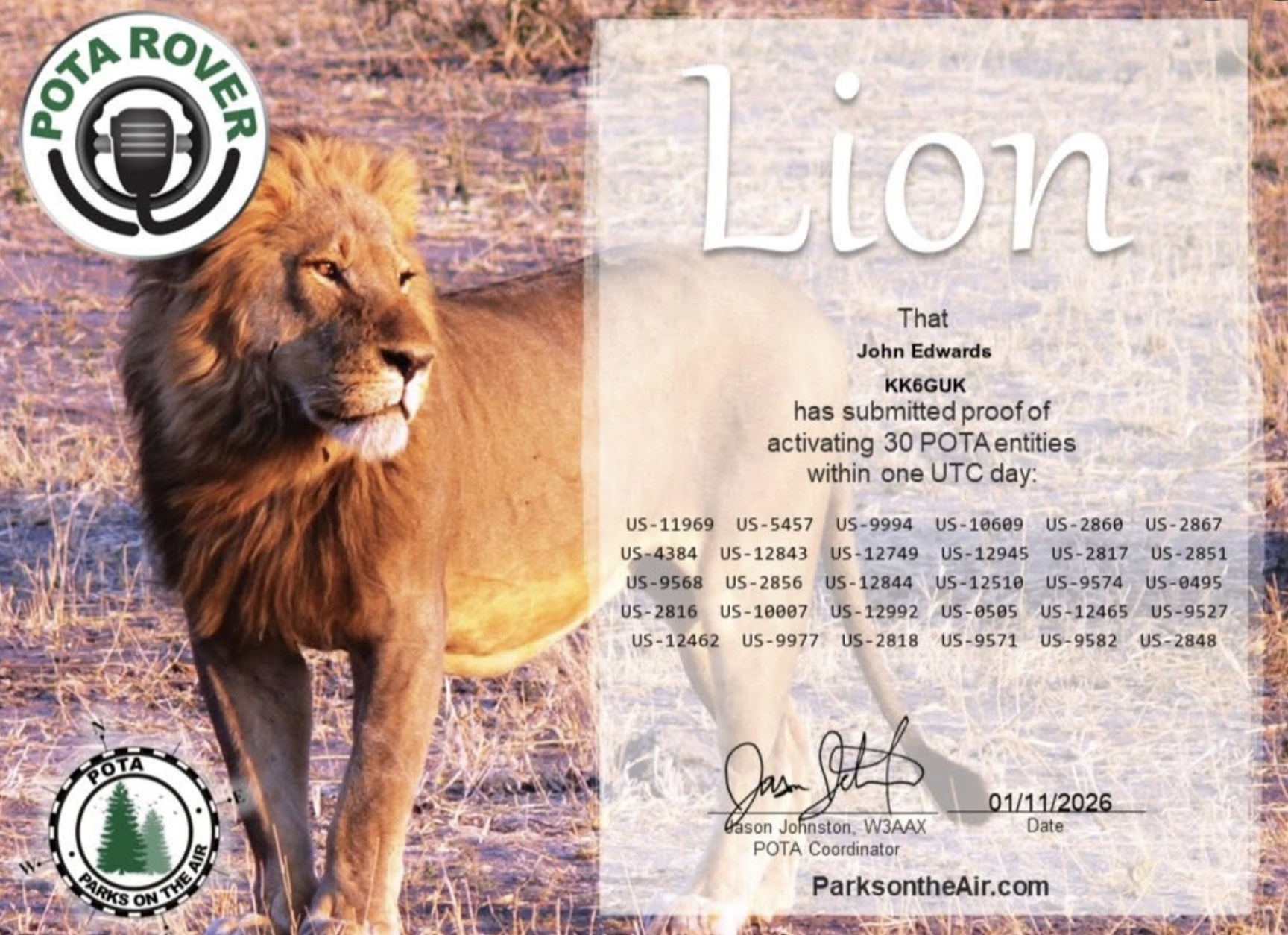
On Jan 11, 2026, Gary (N6BLU) and John (KK6GUK) set out to achieve a rare POTA goal by attempting a 30-park rove. The Lion award is granted to anyone who activates 30 parks during one UTC Day. Activators only get the tier award for the number or parks activated during a UTC Day, so no 5-10-15-20 & 25 activation awards are given if you activate 30 parks. Oh Darn, we must go have more fun activating multiple parks in one UTC Day to get the other awards.
Back in late summer 2025, I threw it out there to Gary (N6BLU) about a rove, and surprisingly he liked the idea. Planning the rove involved a lot of brainstorming, multiple discussions, a lot of mapping, more discussions, more mapping, looking at equipment, mini park roves and activations, and just getting out and activating using different radios and antenna set-ups.
We are somewhat lucky here on the Southern Oregon Coast in that we have quite a few parks to choose from, and as such, they are fairly close in distance and not far off a major highway. We knew we had good radios, various antenna set-ups, and knowledge of the area. What we didn’t know was how difficult each individual park would be to activate. The timing to get in and out quickly, the changing band conditions, road conditions, weather, and park hours to name a few.
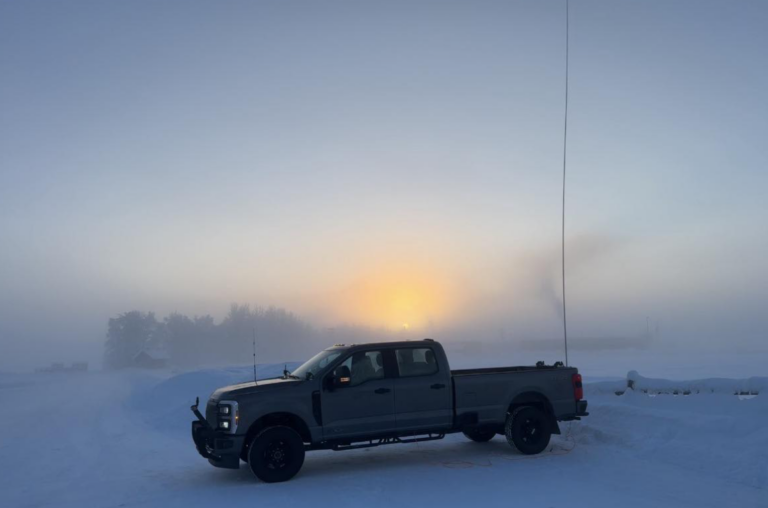
The radios were easy since we each have and are familiar with the Yaesu FT-891. Gary N6BLU has one permanently mounted in his truck that he uses all the time. I also have one in my car that is easily taken in and out as I use it in multiple places. I have a Yaesu FT-710 and because of its relatively small size it was our 1st choice primarily for the filtering and waterfall display. Not critical by any means but nice to see where the signals were on the display. Both radios were hooked up in N6BLU’s truck, and an Alpha Delta switch was used to go between them as needed.
A minor problem presented itself during a previous mini rove to activate some parks was the weight of the radio sitting on the Harbor Freight protective case. A lap computer table was quickly purchased to rest the radio on my lap while driving between parks. This was still a lot of weight on the lap, but more effective and easier to operate the radio for the passenger.
As far as antennas went, you wouldn’t know if you followed us on the rove, but this was a very lengthy discussion. We brought a plethora of antennae with us. The Yaesu ATAS-120A mounted on the back of Gary N6BLU’s truck, 2-EFHW which was a 49;1 & 9;1 (9:1 was to give us the 80/75 m option) the 49:1 was a chalk line antenna, with the intent to break down faster if needed. We also had the Chameleon 25 ft whip, with a 5;1 balun (for multi-band use if needed) with a small tripod. Even deeper in the bag If needed, we also had a JPC -12 vertical and a Buddi-Pole Deluxe. Back-up upon back-up. The ATAS was the rock star. But we did deploy the Chameleon at Sunset Bay State Park (US-2856), which was a two-fer with Ocean Shore State Recreation Area (US-9568) that required us to set up and activate between the vegetation line and the shoreline. This was really our only shot at activating the Ocean Shore Rec. Area. I had done an activation in California with the Chameleon setup, so that trial was done.
We went out a few months before the rove and activated each park on the list with the ATAS-120A. We use the pota.app, Google maps, potamap.us and ONX maps to research and know each parks boundaries. We knew where to park, what the terrain was and how effective the ATAS-120A vertical would be, even in areas with steep terrain.
So, we had radios, antennas, where to activate from for each park, and had a knowledge of the area. Next, we worked out a rough order of the parks we were going to attempt, however that list was still fluid right up until the day of rove. The last couple of items out of our control were the weather; We paid attention 10 days out and it was looking great! Traffic: Slow drivers and accidents, being that this was on a winter weekend, we felt confident that heavy traffic or road work would not be an issue on Highway 101. Band conditions; The Sun threw us an attitude the night before. We talked for about one minute about postponing, but we coped our own attitudes and went for it. If you think about it, if you do not get on the air and try, you won’t make any contact’s. We figured we would know within a couple hours if propagation was going to stop us.
You don’t realize just how much help you need during a multiple park rove, and luckily, we had it. We obtained many followers, Hams that are called hunters that watched the pota.app web page and kept track of us while we moved from park to park, spotting us, holding the frequency for us, and even telling other hams about our rove. One ham in Arizona and another in Canada followed us and helped us retain a frequency between some of the parks so hunters could catch us again in the new park. Some of the Hams that followed us made it possible to get our contacts fast. K7SEN, KI5MM, K6QAZ, AK6U, K8NEE, KD5EDL, K7YMM, KD7WD, KI7PON, K7YMM, ZACK K7FC who helped us set up and breakdown on the beach, and many more whom I am sure I forgot, but am very thankful for.
Luckily, we didn’t really run into any problems. We did outsmart ourselves the next morning by waiting for the gray line on 20 meters to reach us. That first park took us 2 hours to activate and kind of put us up against the clock. If we had just put up the Spider-beam Mast, gone to the 9:1 EFHW we could have got on 75m and made some contacts. Another mistake was that we stopped at Wendy’s to grab some dinner around 0400 UTC on Saturday night. This killed our momentum, and we lost most of our followers. This caused us to only get 4 contacts at our next scheduled park, the Coquille Valley Fish and Wildlife Area (US-12945), before the bands went silent and made us have to go back the next morning to finish it up. Again, we could have and should have setup for 75 meters. The good luck with it all was that by us going out there, you would not even have known the band report was bad. 99% of our parks were activated in under 20 minutes. Once again, the followers, and by using 2 meters, 220, and 440 simplex, to get some of our locals when the HF bands were not cooperating helped us fill in the gaps.
In the end we ended up activating 31 parks with 398 total contacts. Even though this is “Just ham radio,” this was a sense of accomplishment. Our drive home was quiet, we barely spoke while munching on chips and dip. We were not too proud to admit that we were tired! In the days leading up, I had reached out and developed a rapport with some hams that are part of the POTA help desk and POTA operators themselves. After Gary (N6BLU) and I talked at his house afterwards, He had mention that he believed this was an award that was probably not obtained by many. I had asked the help desk if they had numbers and found that indeed they did. We became the 97th and 98th POTA activators to get the Lion award worldwide. Activating 25 parks only had 70 hams worldwide. Challenge accepted, in due time and maybe planning different parks, You game Gary?! Any questions please email me at jde700r@gmail.com.
Thanks to all from KK6GUK & N6BLU 73s and hope to get you down the log soon.